


Traceability for a Food Delivery Platform
Introducing QueryBase, our new web-based model browsing platform. It transforms how teams explore, analyze, and verify complex system architectures. This case study demonstrates how QueryBase’s intuitive navigation and powerful element querying features speed up critical analysis tasks within a modern Food Delivery Platform.
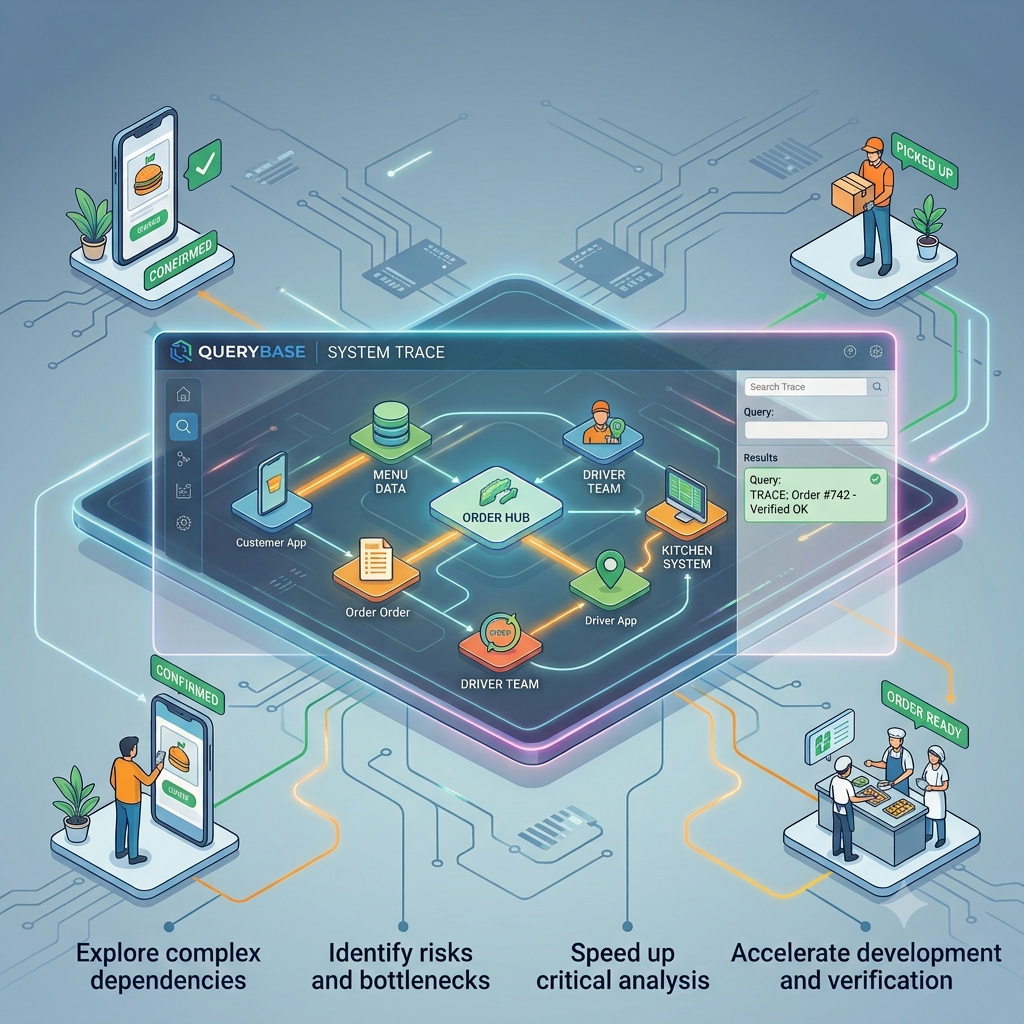
The Scenario
A Modern Food Delivery Platform
Our subject organization manages a highly integrated Food Delivery Platform, structured into four distinct projects:
- Customer Ordering System
- Delivery and Logistics Management
- Payment & Transaction Handling
- Restaurant Partner Management
Intuitive Browsing and Core Workflow Analysis
Step 1: Analyzing the Core Ordering Process
Maya first focuses on the system’s most common workflow: Placing a Food Order. She selects the Customer Ordering System project to open the Project Dashboard.
She quickly locates the sequence diagram link, “Place Food Order,” and clicks it to open the visual flow.
Step 2: Deep Dive into Service Logic
The Sequence Diagram opens, illustrating the intricate ordering steps. To understand the primary business logic responsible for recording the transaction, Maya clicks on the LifeLine: “Order Service”.
Instantly, the specification pane opens at the bottom. This allows Maya to review the service’s responsibilities, detailed description, and any associated properties or technical metadata, all within the context of the diagram view.
Step 3: Reviewing the Structural Model
Next, Maya needs to examine the data structure supporting the ordering process. Using the clear breadcrumb navigation, she quickly returns to the Project Dashboard.
From the diagram list, she clicks on the Class Diagram link “MVC Class Diagram” to review the architectural design and the relationships between the customer ordering components.
Tracing Complex Workflows with Powerful Querying
Maya has verified the successful ordering flow. Her next task is to audit the less frequent but critical Request Refund process. The challenge: she can’t recall if this use case is modeled under the Customer Ordering System or the Payment & Transaction Handling project.
Manually checking multiple large projects is inefficient. This is where QueryBase’s universal element querying provides its greatest value.
Step 4: Initiating a Targeted Search
Maya clicks the magnifier icon (🔎) to open the dedicated Query Interface.
She sets a precise condition: list all elements across all projects where the Name property contains the text ‘Refund’.
Step 5: Focusing Results on Use Cases
Maya clicks Search. The initial result is comprehensive. She uses the Element Type filter to quickly refine the list, unchecking everything except ‘Use Case’.
The result is immediately targeted, listing “Request Refund : Use Case,” and identifying its location in the Payment & Transaction Handling project—the exact information Maya needed, found in seconds.
Step 6: Instant Navigation and Traceability
Maya clicks on the search result ‘Request Refund : Use Case’.
QueryBase instantly opens the associated Use Case Diagram. The “Request Refund” use case is highlighted, and the specification pane is displayed, providing its properties and documentation.
Step 7: Following the Flow to Implementation
To complete her verification, Maya needs the technical details of the refund process. She switches to the “Diagrams” tab within the specification pane. This view lists all related implementation diagrams linked to the selected use case.
She clicks the link for the sequence diagram: “Request Refund.”
This single click takes Maya directly to the Sequence Diagram, enabling her to instantly analyze the main and alternative interaction flows for refund processing and complete her audit.
Conclusion
Validation Speed and Model Trust
Using QueryBase, Maya seamlessly navigated from high-level project exploration to deep service analysis. She then leveraged the powerful Query feature to instantly find and trace a complex, multi-project workflow.
QueryBase cuts down model discovery time, boosts QA and analysis speed, and ensures every team member can trust and access the definitive source of system knowledge.